Colorblocking When Everything You Own Is a Different Shade of Grey

Quick Answer: Greys clash because they have undertones — some lean blue, some lean brown. Sort your greys by undertone first, then build blocks by contrast in lightness rather than in hue. Two greys three or more steps apart on a light-to-dark scale read as a deliberate block; two adjacent greys read as a mistake.
You own eleven grey pieces and no two of them look like they were meant to be together. It is not bad luck — it is that grey is the least neutral neutral there is.

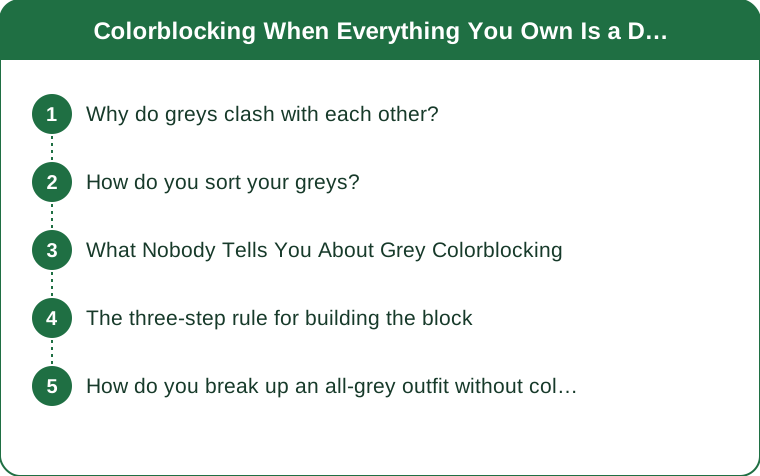
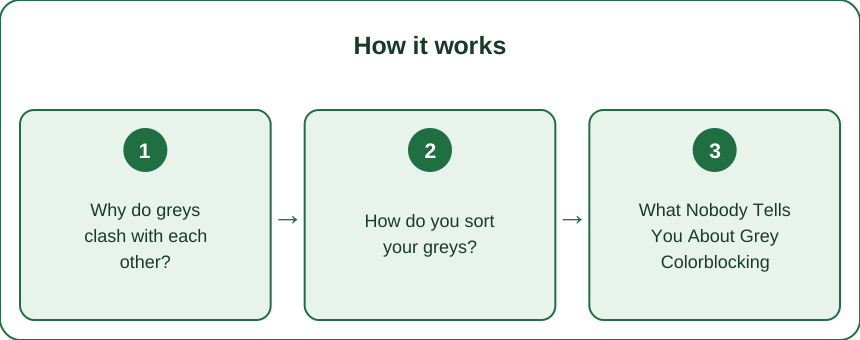
Why do greys clash with each other?
Because almost no grey is truly neutral. Most carry an undertone from the dye process or the fibre blend — cool greys lean blue or violet, warm greys lean brown or yellow, and a smaller group sits close to true.
Put a cool grey next to a warm grey and your eye does not read two greys. It reads one grey and one slightly-wrong colour, because the eye judges colour relatively and the comparison makes the undertone obvious.
The second problem is lightness spacing. Two greys that are close in value but different in undertone are the worst possible pairing — too similar to read as contrast, too different to read as a match. That is the combination that makes an outfit look accidental.
Both problems have the same solution: sort by undertone, then space by lightness.
How do you sort your greys?
Do this once, in daylight, with everything on the bed. It takes ten minutes and it changes how you dress for the next two years.
Step 1 — undertone. Lay each piece against a sheet of plain white paper. Against true white, the undertone becomes obvious: bluish, brownish, or neutral. Make three piles.
Step 2 — lightness. Within each pile, order light to dark. Assign each a number 1 to 5, where 1 is nearly white and 5 is nearly black.
Step 3 — photograph it. One photo of the sorted layout on your phone. This is the reference you will actually use, because you will not remember which charcoal is the warm one.
Most people discover they own two greys in one undertone family and nine in another, which immediately explains why one particular pairing always looked wrong.

What Nobody Tells You About Grey Colorblocking
Fabric changes the undertone. The same dye reads warmer on brushed fleece than on smooth nylon, because texture changes how light scatters. Two pieces that match on paper can separate on the body.
Heather grey is a different animal. Marled or heathered grey is a blend of fibres, usually including white and black or a colour. It reads lighter from a distance and does not sit cleanly in any undertone pile. Treat heather as its own category — it works best as the lightest block, never as a mid-tone.
Black is not the darkest grey. Putting black next to charcoal usually looks like a mistake rather than a block, because the step is small but the material difference is large. Use black with a light grey — a genuine value gap — or not at all.
Washing shifts greys warmer. Repeated washing and hard water pull most greys slightly warm and slightly lighter over time, which is why an old set no longer matches the new piece you bought to go with it.
The three-step rule for building the block
Once sorted, the rule is simple: pair pieces at least three lightness steps apart, within the same undertone family.
- 1 and 4 — light grey top, dark grey legging. Clean, obvious, always works.
- 2 and 5 — mid grey and near-black. The most versatile pairing for gym wear.
- 1 and 5 — maximum contrast. Strong, and it needs a third element to soften it.
Avoid 2 and 3, or 3 and 4. Those are the near-misses.
For a three-block outfit, use 1, 3, and 5 — evenly spaced. Put the darkest block on the largest area, usually the legs, and the lightest on the smallest. This is why light top with dark bottom reads as considered and the reverse often does not.
If two pieces are from different undertone families and you want to wear them anyway, separate them with a third piece rather than putting them edge to edge.
How do you break up an all-grey outfit without colour?
Texture and hardware do the work that colour normally would.
Texture contrast. Ribbed against smooth, brushed against matte, mesh against solid. A ribbed grey top over smooth grey leggings has a visible boundary even when the two are the same value — the eye reads the texture change as an edge.
One hardware accent. A white shoe, a metal zip pull, a coloured elastic. One is deliberate; three is confetti.
A seam or panel line. Pieces with contrast panelling create internal blocks without needing a second garment.
A single skin gap. A cropped top or pushed sleeves breaks the field visually and stops the outfit reading as one continuous grey column.
The quiet advantage of an all-grey wardrobe is that once it is sorted, nothing ever clashes badly — you are only ever choosing between good and slightly better. That is a much easier morning than a drawer full of colours that half-work.
TL;DR:
- Greys clash because of undertones — cool blue-greys and warm brown-greys read as different colours side by side.
- Sort once in daylight against white paper: three undertone piles, then order 1-5 by lightness.
- Pair pieces at least three lightness steps apart within the same undertone family.
- Use texture, one hardware accent, or a seam line to break up the field instead of colour.
The ten-minute sorting session is the entire trick. Most grey wardrobes are not badly bought — they are just unsorted, and the two pieces that never worked together were never going to. Photograph the layout and you will stop making the same pairing mistake by accident.
See It in Motion
Seen here: Super High Waist Embossed Yoga Leggings with Inner Pocket — shop it on bubblelime.com
Keep Reading
This article is for general informational and styling purposes only. Fit, sizing, and product availability may vary.