Colour Blocking Once You Have to Add a Jacket
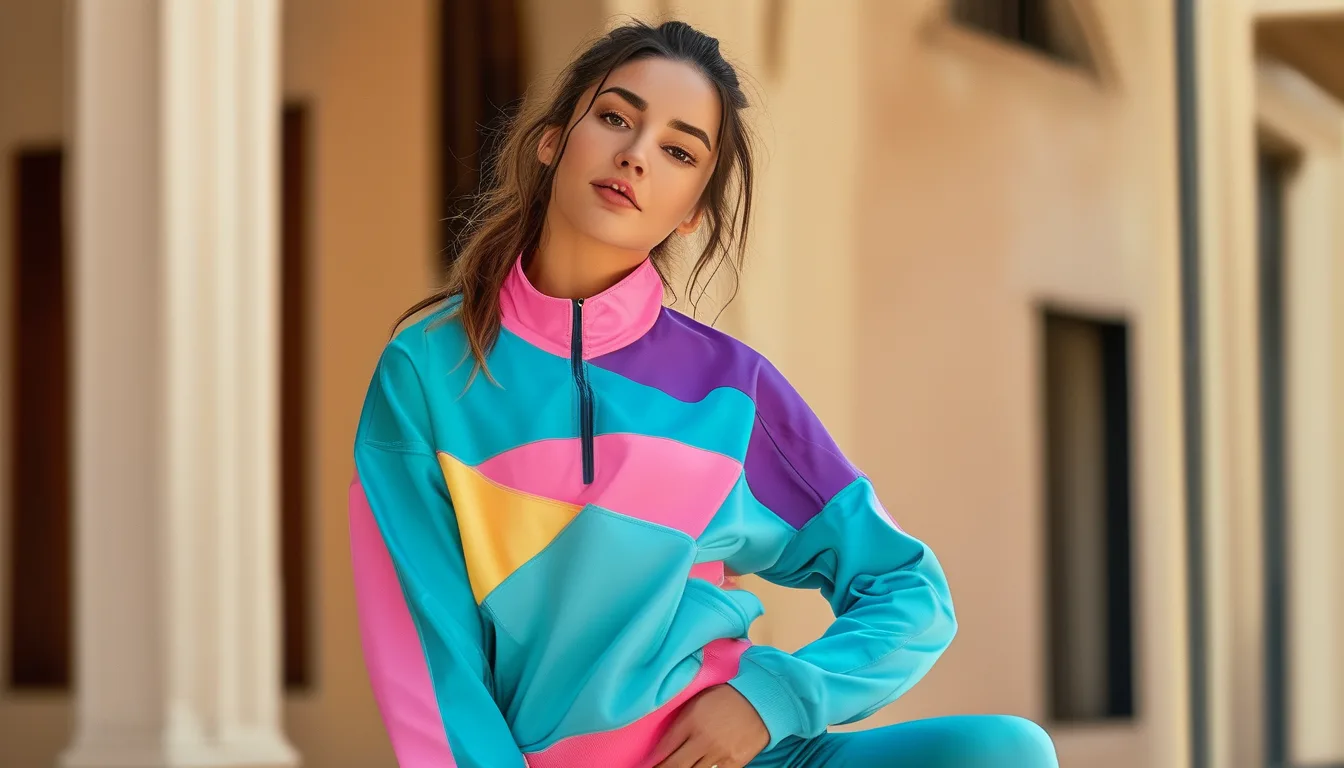
Quick Answer: Adding a jacket to a colour-blocked outfit turns a balanced two-colour look into an unbalanced three-colour one. The reliable fix is making the jacket a neutral that sits outside the colour story entirely, or matching it exactly to one of the two colours already there. What doesn’t work is introducing a third colour - that’s where colour blocking stops reading as deliberate.
Your navy and rust set looked great all summer. Add a green jacket and something’s off.
The outfit didn’t get worse. It got a third colour, and three is where colour blocking usually breaks.
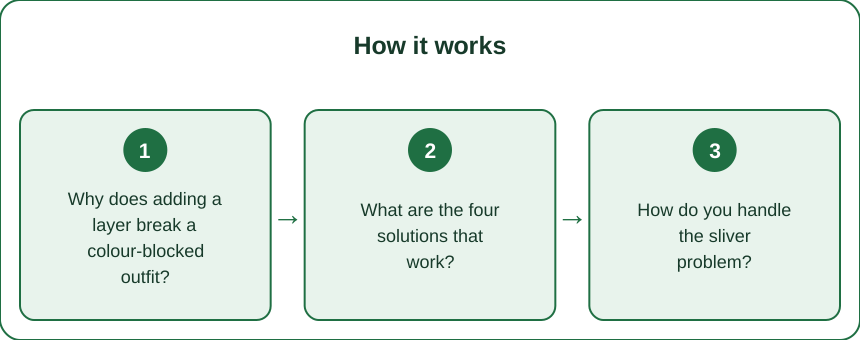
Why does adding a layer break a colour-blocked outfit?
Because colour blocking depends on a clear relationship between a small number of blocks.
The whole premise is deliberate contrast between defined areas. Two colours read as a decision. Three read as a decision only if the third has an obvious role - as an accent, or as a repeat of something already present.
A jacket is a large area, which is the problem. It covers the torso, which was one of your two blocks, so it doesn’t add a small accent - it replaces a major block and adds a new one simultaneously. The original balance is gone.
Proportion shifts too. A colour-blocked set is usually balanced roughly half and half. A jacket over the top makes the upper half a different colour and reduces the original top to a visible strip, which changes the ratio to something like a third, a sliver, and a half.
The two things that go wrong:
- Three colours with no hierarchy - nothing reads as dominant, and the eye has nowhere to settle
- A visible sliver of the original top creating an accidental fourth element between jacket and legging
The good news: both have straightforward fixes, and neither requires buying a jacket in a specific colour.
What are the four solutions that work?
In order of reliability.
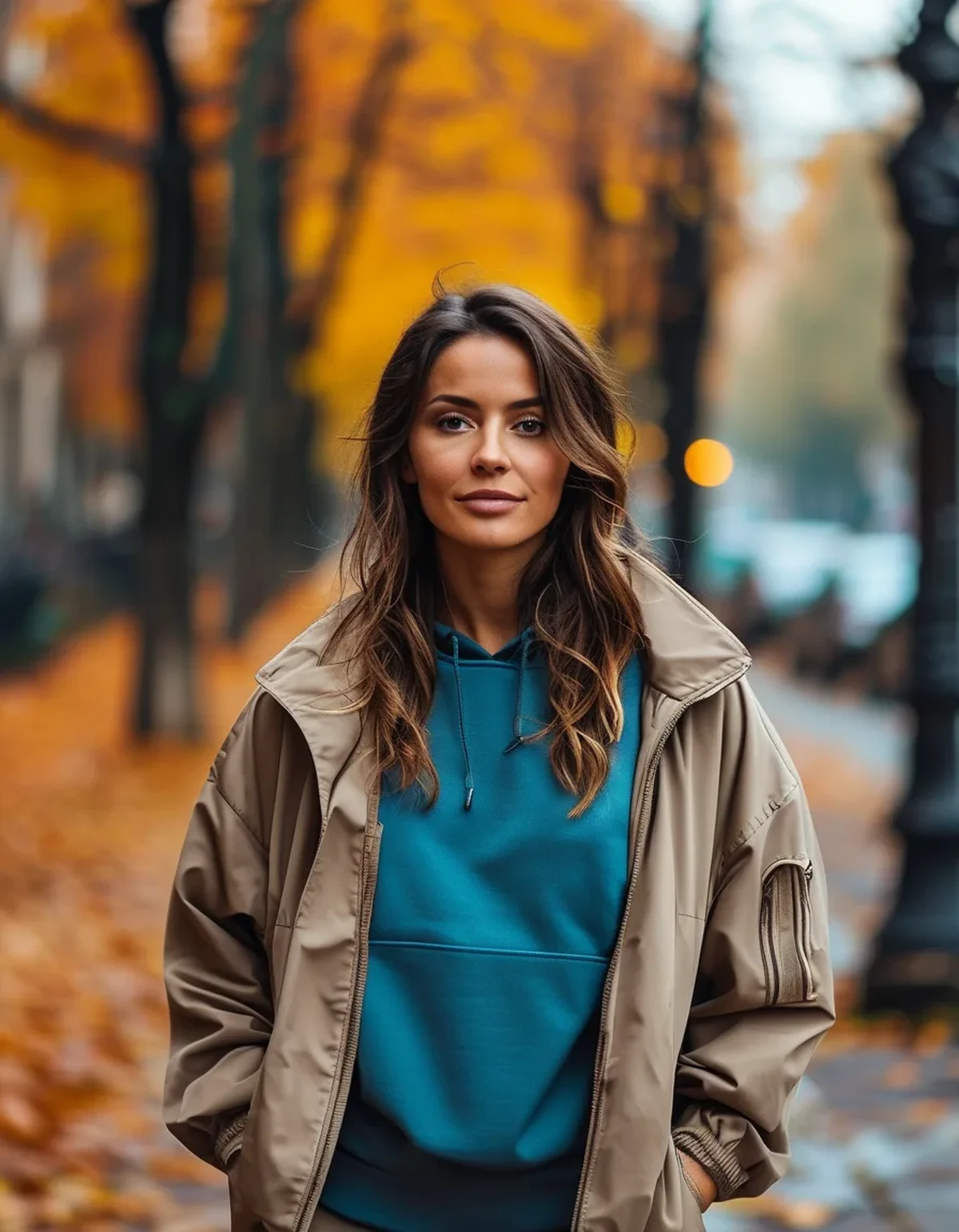
1. Neutral jacket, outside the colour story. The most reliable. Cream, camel, chocolate, grey, black, or olive - a colour that reads as a frame rather than as a participant.
Why it works: the neutral doesn’t compete for attention, so your original two colours remain the outfit and the jacket reads as outerwear. Cream and camel are strongest here because they warm the palette at the same time.
2. Jacket matching one of the two colours exactly. A navy jacket over a navy-and-rust set keeps the count at two. This creates a vertical navy column with rust as the accent, which is a strong and slimming arrangement.
The requirement is that it matches properly - a nearly-navy jacket over a navy top reads as an error rather than a choice. Same colour or a clearly different colour; nothing in between.
3. Jacket in a deeper shade of one colour. Burgundy jacket over a rust and cream set - tonal rather than matching. Sophisticated and slightly harder to execute, since the shades have to be clearly related rather than nearly identical.
4. Zip it up and make the jacket the top block. The simplest solution nobody mentions. A closed jacket removes the original top from the equation entirely, and you’re back to a clean two-block outfit: jacket and leggings.
What doesn’t work: a third unrelated colour. Green jacket over navy and rust is three competing statements, and there’s no arrangement of them that reads as intentional.
How do you handle the sliver problem?
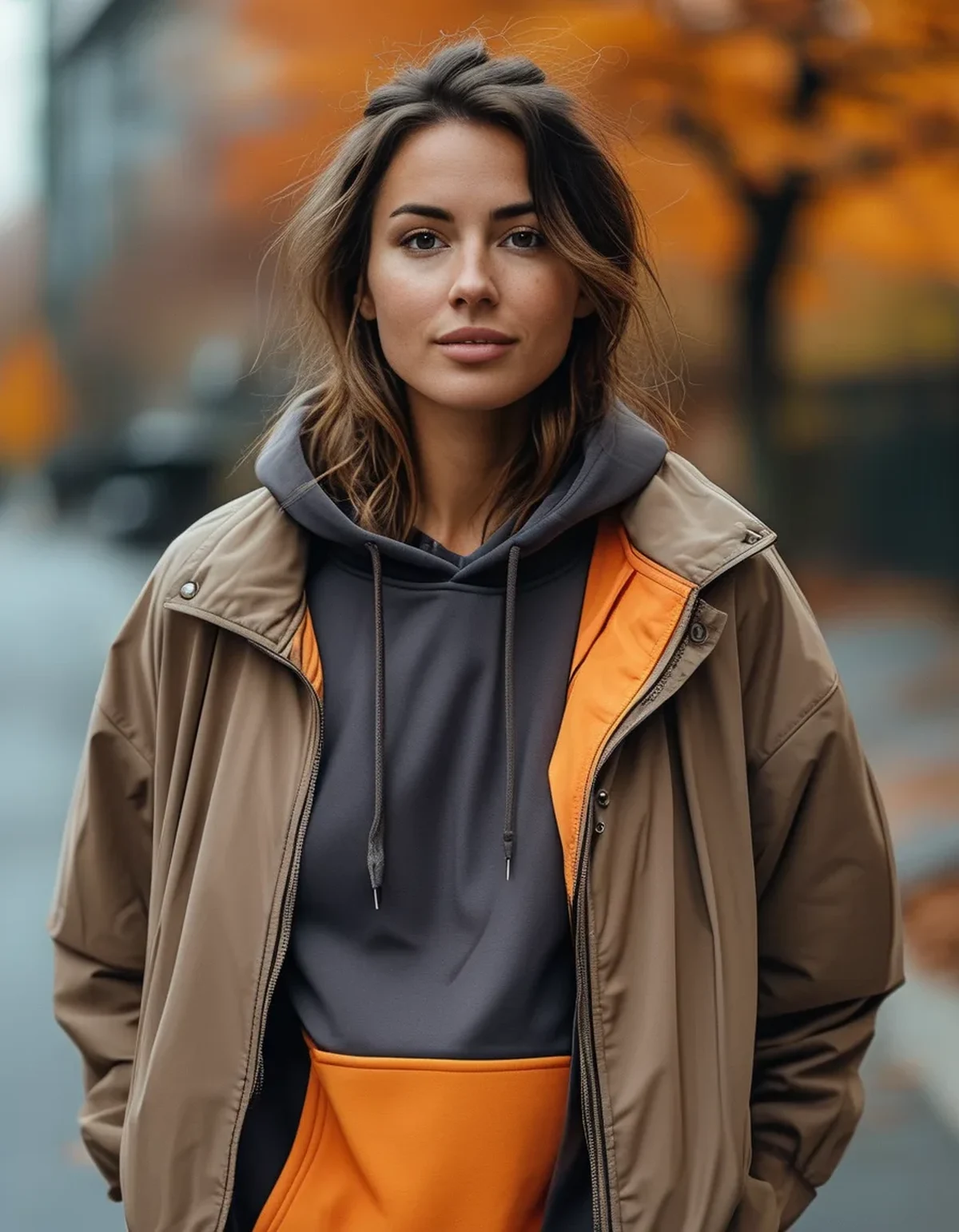
The strip of original top visible between an open jacket and the waistband.
Three fixes, in order of ease.
1. Make the sliver the accent deliberately. If the visible strip is a colour that appears elsewhere - in the shoe, a stripe on the legging, a bag - it reads as intentional repetition. Colour repeated twice in an outfit always looks planned; colour appearing once in a small area looks accidental.
2. Extend the top so it isn’t a sliver. A longer top that shows a proper section below the jacket hem is a block, not a strip. The general threshold is roughly a hand’s width - less than that reads as a gap rather than a section.
3. Eliminate it. Zip the jacket, or tuck the top so nothing shows between jacket and waistband.
A related detail: hem lines create horizontal breaks, and where they fall matters more than the colours do. A jacket hem landing at the widest part of the hip is the least flattering common option. Either above the hip bone or below the widest point works better.
And on shoes with three-layer outfits: match the shoe to the jacket or to the legging, not to the top. The top is now the smallest visible area, and pulling the eye down to a shoe that matches it fragments the outfit.
The general test: stand in front of a mirror and squint. You should see two or three clear blocks, not five fragments. Squinting removes detail and shows you the actual structure, which is what other people register first.
5 Colour Blocking Mistakes Once Layers Are Involved
The specific autumn versions.
1. Adding a third colour because you own that jacket. The most common by far. A neutral jacket is the single most useful colour-blocking purchase, and if the one you own is a third colour, zipping it up is a free fix.
2. Nearly-matching rather than matching. A slightly different navy next to your navy reads as a mistake, where a completely different colour would have read as a choice. Exact or clearly different - never close.
3. A jacket hem at the widest part of the hip. Creates a horizontal line at the least flattering point. Shorter or longer both work better, and it’s worth checking in a mirror rather than assuming.
4. Forgetting the bag and shoes are blocks too. A three-colour outfit plus a fourth-colour bag is four blocks. Accessories count, and they’re the easiest place to reduce.
5. Symmetrical blocking with a layer over it. Colour blocking generally looks better asymmetric - unequal areas rather than a clean half-and-half. Once a jacket is involved, symmetry becomes almost impossible to maintain anyway, so leaning into unequal proportions is the easier path.
The single rule that prevents most of it: decide which colour is dominant before you leave. Every well-blocked outfit has one colour doing more work than the others, and layers make that hierarchy more important rather than less.
FAQ: Layered Colour Blocking Questions, Answered
What’s the best jacket colour for colour blocking?
Cream or camel. They frame any two-colour combination without joining it, they warm the overall palette for autumn, and they work with brights that black tends to flatten.
Can I colour block with three colours at all?
Yes, when one is clearly dominant, one supporting, and one a small accent - roughly a 60-30-10 split. What doesn’t work is three colours in similar proportions, which is exactly what adding a jacket tends to produce.
Does a print piece count as a colour block?
It counts as at least one, sometimes two if the print has strong contrast. Treat a print as a block and keep everything else plain - a print plus two solid colours plus a jacket is too many elements.
How do I colour block if I only own black leggings?
Black is a strong base for it - put the colour on top and in the shoe. Black legging, bright top, cream jacket is a clean and easy colour block, and swapping the top gives you a different outfit each time.
Should the jacket match the shoes?
It’s one of the safest options, and matching the shoe to the leggings is equally good and often more elongating. What to avoid is matching the shoe to the smallest visible area, which fragments the outfit visually.
TL;DR:
- A jacket doesn’t add a small accent - it replaces one of your two blocks and adds a new one
- Best fix: a neutral jacket outside the colour story, ideally cream or camel
- Second best: a jacket matching one existing colour exactly - exact or clearly different, never nearly
- Zipping the jacket turns three colours back into two for free
- Fix the sliver between jacket and waistband: repeat the colour elsewhere, lengthen the top, or eliminate it
- Squint in the mirror - you should see two or three blocks, not five fragments
Three colours isn’t the problem. Three colours with no hierarchy is.
See It in Motion
Seen here: High Waist 8” Yoga Shorts — shop similar styles on bubblelime.com
Keep Reading
This article is for general informational and styling purposes only. Fit, sizing, and product availability may vary.